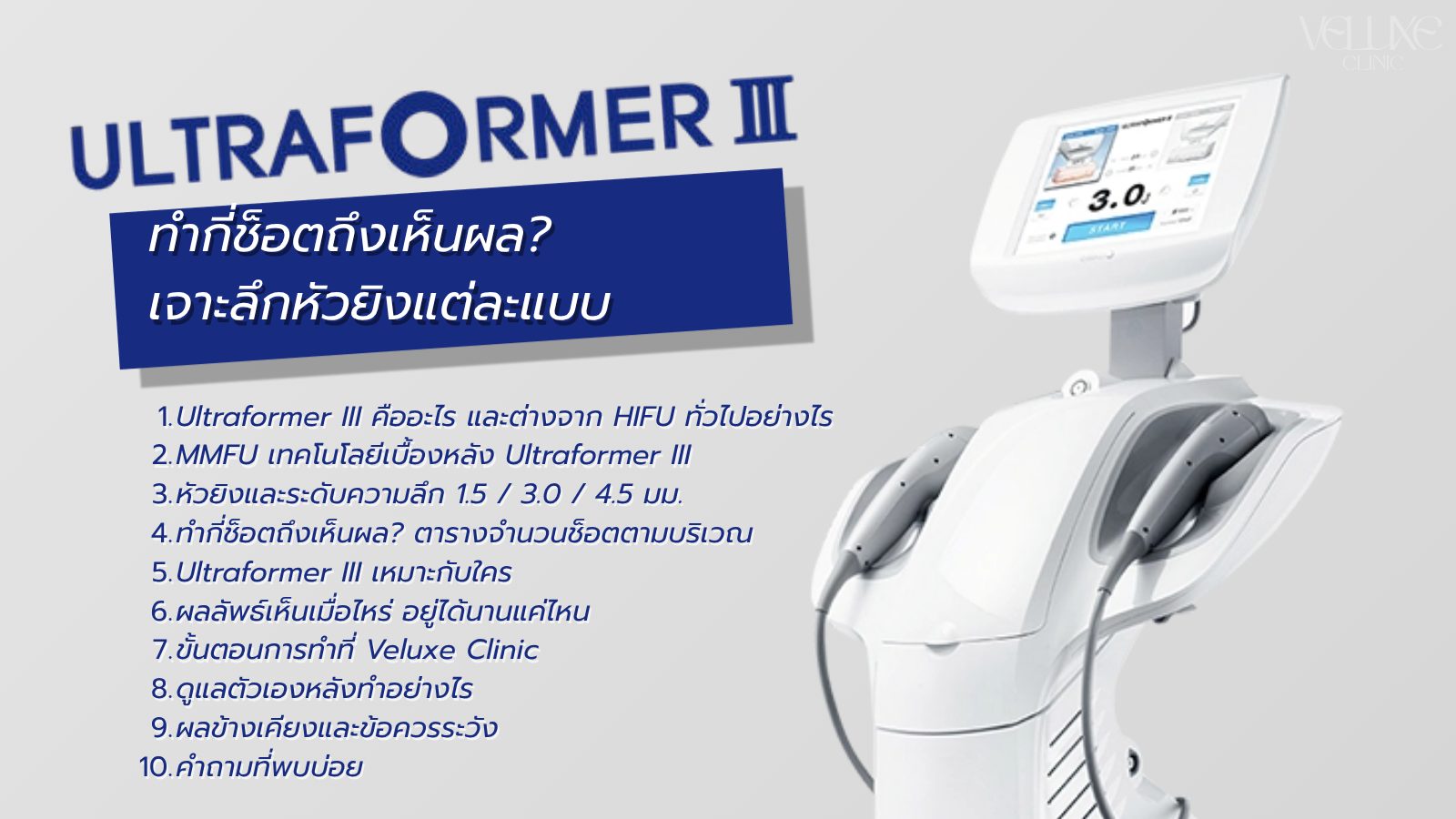
📋 Contents
- What Ultraformer III is and how it differs from ordinary HIFU
- MMFU: the technology behind Ultraformer III
- Transducers and depths: 1.5 / 3.0 / 4.5 mm
- How many shots until results? Shot counts by area
- Who Ultraformer III suits
- When results show and how long they last
- Treatment steps at Veluxe Clinic
- How to care for yourself afterwards
- Side effects and precautions
- Frequently asked questions
If you're starting to feel that your jawline isn't as defined as before, your cheeks are starting to sag, or you have a double chin, but you don't want a surgical facelift yet, Ultraformer III is one of the most talked-about lifting machines in Thailand. This article digs into the most common questions: how the transducers differ, how many shots you need, and how to care for yourself afterwards, so you can talk to the doctor with understanding before deciding.
💡 Read more: If you're new to Ultraformer III, we recommend reading Getting to know Ultraformer III: what the lifting machine is and whether it's good first for the basics, then come back to this article for the details on transducers and shot counts.
What Ultraformer III is and how it differs from ordinary HIFU
Ultraformer III is a non-surgical lifting machine for the face and body, made by Classys of South Korea. It works with focused high-frequency ultrasound, delivering energy to skin layers deeper than creams or ordinary lasers can reach.
People generally call this group of machines “HIFU” (high-intensity focused ultrasound), but what sets Ultraformer III apart is MMFU technology, which combines both micro and macro waves in one machine, so treatment can be adjusted for both deep lifting and superficial skin refinement in the same course.
The Ultraformer III machine
Showing the machine and its various transducersMMFU: the technology behind Ultraformer III
MMFU stands for Micro & Macro Focused Ultrasound The principle is to focus ultrasound energy on small points beneath the skin until heat builds to about 60–70°C at that point, called a Coagulation Point without damaging the surface skin.
Heat at this level causes two things at once:
- Existing collagen contracts immediately (immediate contraction) — why many people feel their face is tighter from day one
- New collagen is stimulated (neocollagenesis) — the body repairs the heated points, building new collagen and elastin continuously for 2–3 months, the true long-term result
💡 Put simply: Ultraformer III doesn't “pull” skin up like surgery; it makes the body build new supporting structure itself, so it takes time and the result looks natural.
Transducers and depths: 1.5 / 3.0 / 4.5 mm
The heart of Ultraformer III is its transducers (cartridges) Each one delivers energy at a different fixed depth, and the doctor chooses according to the problem and area being treated.
| Transducer | Depth | Target skin layer | Used for |
|---|---|---|---|
| 1.5 mm | Shallowest | Epidermis – superficial dermis | Around the eyes, eyelids, fine lines, thin skin |
| 2.0 mm | Shallow | Superficial dermis | Around the mouth, shallow nasolabial folds, overall facial skin |
| 3.0 mm | Moderate | Deep dermis | Cheeks, jawline, moderate sagging |
| 4.5 mm | Deep | SMAS layer | Jawline, under the chin, double chin, main lifting |
| 6.0 / 9.0 mm | Very deep | Deep fat | Under the chin, body, upper arms, abdomen |
Why 4.5 mm matters most
The 4.5 mm level is the SMAS (superficial musculoaponeurotic system) layer, the tissue layer surgeons pull up during a facelift. Delivering energy to this layer without cutting the skin is why HIFU is called a “non-surgical facelift”.
⚠️ Worth knowing: using the 4.5 mm transducer requires high skill, because firing in the wrong place, such as areas with little fat or near nerves, may cause fat to sink into a hollow or temporary numbness. It should only be done by an experienced doctor.
How many shots until results? Shot counts by area
The most popular question is “how many shots do I need?” There's no fixed number, as it depends on face size, degree of sagging and the areas being treated, but these are the typical ranges:
| Area | Approximate shots | Common transducers |
|---|---|---|
| Jawline + cheeks (full face) | 300–400 shots | 4.5 + 3.0 mm |
| Under the chin / double chin | 100–200 shots | 4.5 + 6.0 mm |
| Around the eyes | 50–100 shots | 1.5 mm |
| Neck | 150–200 shots | 3.0 mm |
| Full face + neck (full course) | 500–800 shots | Several transducers combined |
💡 What matters more than shot count: more shots don't always mean better results. Placing the lines (vectors) in the right lifting direction and choosing transducers that match the problem matter far more than the number. A good clinic assesses your face first and then sets the shot count, rather than just selling number packages.
Who Ultraformer III suits
Ideal for
- People with mild to moderate sagging, especially aged 30–55
- People starting to see an undefined jawline, sagging cheeks or deepening nasolabial folds
- People with a double chin who don't want liposuction or surgery
- People who want Advance prevention and don't want to wait until sagging is severe to fix it
- People with no time for recovery, since you can go back to work straight after
May not suit, or consult a doctor first
- People with already significant especially with clear excess skin — surgery may need to be considered too
- People with a very slim face or little fat beneath the skin — the heat may make them look more tired
- Pregnant or breastfeeding women
- People with infected wounds, severe inflamed acne or skin disease in the treatment area
- People with a pacemaker or metal implants in the face
When results show and how long they last
Immediately after
The face feels slightly tighter from existing collagen contracting; this isn't permanent and may fade within 1–2 weeks
Weeks 2–4
The body starts building new collagen; skin becomes firmer, texture improves and pores look smaller
Months 2–3 (clearest results)
New collagen is fully built: a sharper jawline, less double chin and the clearest visible difference
Months 6–12
Results last, then gradually decline as collagen naturally ages; repeating 1–2 times a year is recommended to maintain results
Treatment steps at Veluxe Clinic
Consultation and skin assessment
The doctor checks the degree of sagging and the fat thickness beneath the skin, and plans which transducers, areas and how many shots
Cleansing and numbing cream
All makeup is removed and numbing cream applied for about 30–45 minutes to reduce sensation during treatment
Mapping the treatment lines
The doctor draws zone lines on the face to set the lifting direction and distribute shots evenly, avoiding uneven results on the two sides
Delivering energy
Takes about 30–60 minutes depending on shot count; you'll feel flashes of heat or twinges at intervals, a sign the energy has reached the target layer
Cold compress and aftercare advice
A cold compress reduces accumulated heat, sunscreen is applied, and you receive aftercare advice to take home
How to care for yourself afterwards
Ultraformer III's advantage is almost no downtime, but the right care helps collagen build better.
✅ Do
- Apply SPF 30+ sunscreen daily Reapply every 2–3 hours outdoors
- Drink enough water at least 8 glasses a day to support collagen building
- Keep skin moisturised Use a moisturiser containing HA or ceramides
- Sleep enough 7–8 hours, as collagen is built most during deep sleep
- Eat protein and vitamin C the raw materials for collagen
❌ Avoid in the first 1–2 weeks
- Sauna, steam room, very hot showers
- Strenuous exercise in the first 24–48 hours
- Vigorous face massage or pressing on the treated area
- Face scrubs or strong exfoliating products (AHA/BHA/retinol) for the first 3–5 days
- Strong sun without protection
Side effects and precautions
Ultraformer III is a very safe procedure when performed by a doctor, but some symptoms can occur, most of which resolve on their own within a few days.
| Symptom | How common | Period |
|---|---|---|
| Slight redness after treatment | Common | 2–4 hours |
| Tightness or tenderness when pressing or chewing | Common | 3–7 days |
| Slight swelling | Sometimes | 1–3 days |
| Patchy numbness | Rare | 2–6 weeks |
| Red lines along the treatment pattern | Rare | 1–2 days |
| Fat sinking into a hollow | Very rare | Requires a doctor's care |
⚠️ What to check before deciding: Ask clearly whether the clinic uses genuine Classys transducers or not, because fake transducers or ones with reset shot counts deliver inconsistent energy, giving poorer results and a risk of burns. Always ask to see the transducer and remaining shots on the machine screen before starting.
Consult an experienced doctor at Veluxe Clinic Chiang Mai
Our aesthetic medical team is ready to assess your skin and design a lifting program just for you. Ask for details and promotions via LINE OA — consultations are free.
Book a free consultation →