📋 Contents
Chemical peeling, or acid exfoliation, is a long-established procedure that remains one of the best-value options for comedones, dull skin and dark marks.
What is chemical peeling
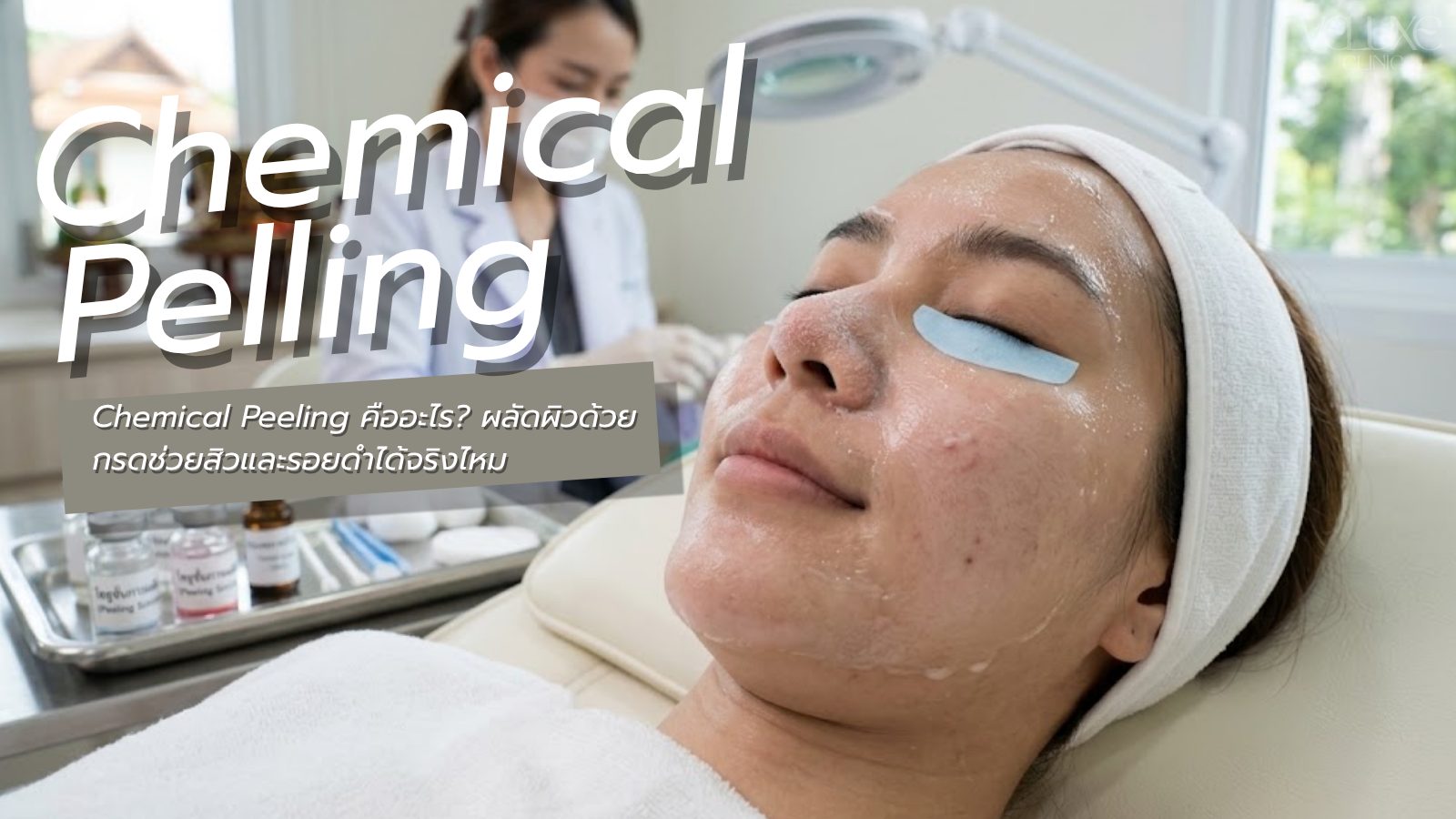
is applying acid-based chemicals to the skin to speed up shedding of the top layer, stimulating the skin to produce new, smoother cells in its place.
Unlike scrubbing, which removes skin by friction — acid works by dissolving the bonds between skin cells, so depth can be controlled more precisely without mechanical damage to the skin.
How each acid differs
| Acid | Properties | Suits |
|---|---|---|
| Salicylic Acid (BHA) | Oil-soluble, penetrates pores | Comedones, oily skin, large pores |
| Glycolic Acid (AHA) | Smallest molecule, penetrates deeply | Dull skin, fine lines, rough texture |
| Lactic Acid (AHA) | Gentle and hydrating | Dry skin, delicate skin, beginners |
| Mandelic Acid (AHA) | Large molecule, penetrates slowly, gentle | Darker skin, sensitive skin, PIH-prone |
| TCA | Strong, deep, hard to control | Deep acne scars (TCA CROSS technique) |
💡 For Thai skin: Mandelic Acid it is often the safest choice for darker skin or skin that marks easily, because its large molecule penetrates slowly, causing less irritation and lowering the risk of PIH.
3 levels of depth
| Level | Depth reached | downtime | Used for |
|---|---|---|---|
| Superficial | Epidermis | 0–3 days | Comedones, dull skin, shallow dark marks |
| Medium | Upper dermis | 5–7 days | Deep dark marks, fine lines, shallow scars |
| Deep | Mid dermis | 2–3 weeks | Deep lines, scars — not commonly used on Asian skin |
⚠️ Asian skin should be careful with deep peels The deeper the peel, the higher the risk of post-inflammatory hyperpigmentation (PIH). For most Thai people, several superficial to medium peels give better and safer results than one deep peel.
What it helps with
- Comedones: whiteheads and blackheads — its greatest strength, especially BHA
- Post-acne dark marks (PIH)
- Dull skin lacking radiance
- Large pores
- Rough, uneven texture
- Fine lines
Not suitable for: deep acne scars, raised scars, deep melasma and severely inflamed acne
Who it suits
Suitable
- People with chronic comedones that topical treatment doesn't control
- People with post-acne dark marks who want them to fade faster
- People who want to improve their skin without laser
- People on a limited budget who want clear results — one of the best-value procedures
Avoid, or consult a doctor first
- People taking isotretinoin or who stopped less than 6 months ago
- People with open wounds, herpes or infection in the area
- Pregnant and breastfeeding women (some acids)
- People with a history of keloid scarring
- People who had laser or waxing in the area within 1–2 weeks
The procedure
Skin assessment
The doctor chooses the acid type, strength and timing to suit your skin and concern
Cleansing and preparing the skin
The face is washed and all oil removed so the acid works evenly
Applying the acid
A thin layer is applied and left for the set time; a slight stinging warmth is normal
Stopping the reaction
Rinsed off or neutralised, then a cold compress reduces irritation
Mask and sunscreen
Skin is nourished and sunscreen applied before you leave — this step must never be skipped
Usually done as a course of 4–6 sessions, 2–4 weeks apart
Aftercare
✅ Do
- Apply SPF 30+ sunscreen daily The most important — new skin is very sensitive to light
- Use a light, hydrating moisturiser
- Cleanse gently with room-temperature water
- Let the skin peel on its own
❌ Avoid for 5–7 days
- Picking or peeling flaking skin — risk of dark marks and scars
- Scrubs, AHA, BHA, retinol
- Sauna, steam room, swimming
- Strong sun
- Waxing the treated area
Risks and precautions
| Symptom | How common | Period |
|---|---|---|
| Stinging warmth during treatment | Common | During treatment, 3–10 minutes |
| Redness afterwards | Common | 2–24 hours |
| Peeling in sheets | Common (depending on depth) | 3–7 days |
| Dry, tight skin | Common | 3–7 days |
| Initial breakouts | Sometimes | 1–2 weeks |
| Dark marks (PIH) | Rare | Several weeks if no sunscreen is used |
⚠️ Don't do strong peels yourself at home High-strength acids sold online can burn the skin, cause permanent scars and leave dark marks much harder to fix than the original problem. Home products should be low-strength formulas designed for self-use.
Consult an experienced doctor at Veluxe Clinic Chiang Mai
Our medical team is ready to assess your skin and design a treatment program just for you. Ask for details via LINE OA — consultations are free.
Book a free consultation →